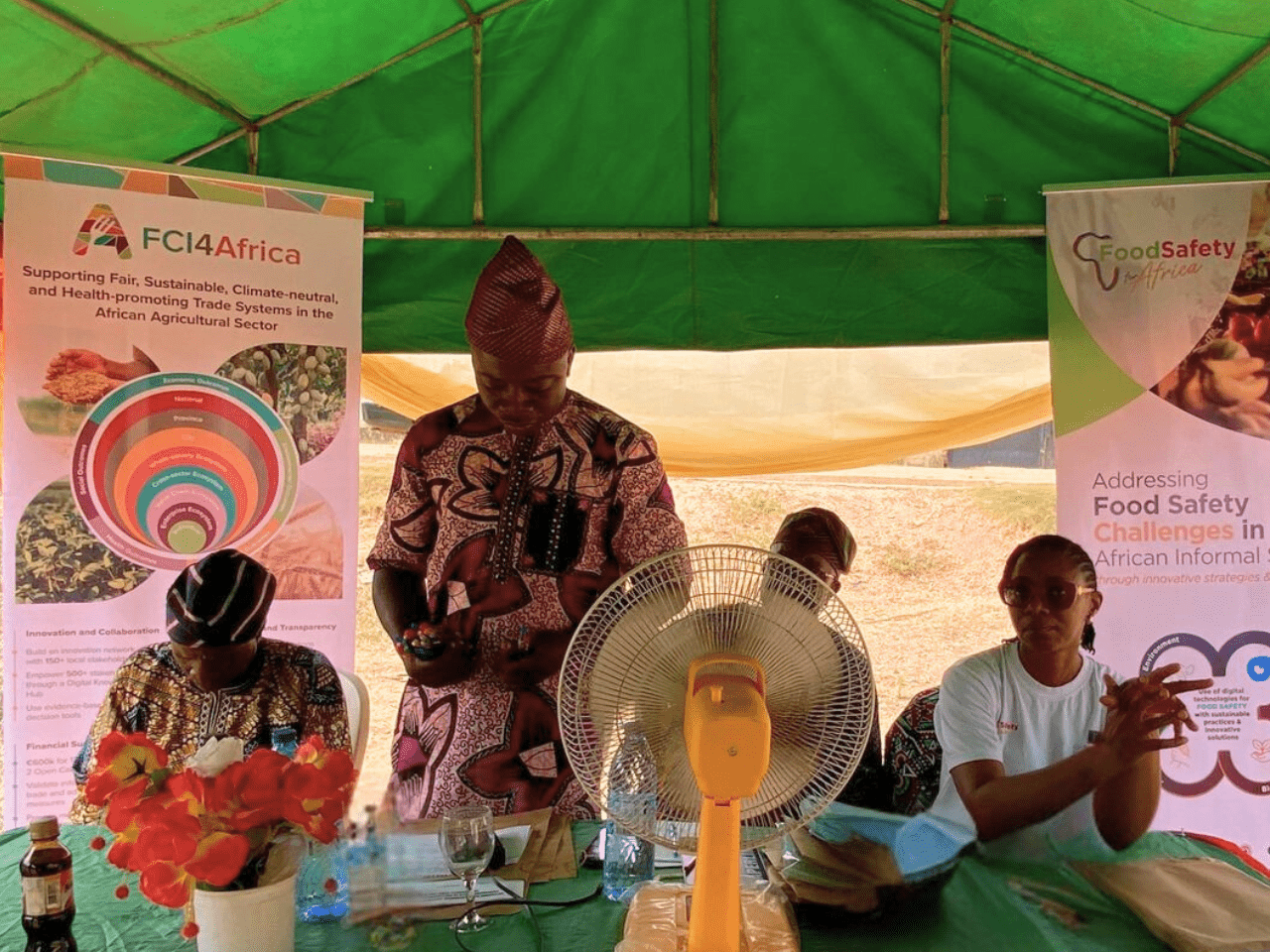
The FCI4Africa project (Fair Food and Trade Systems for Africa through Food Convergence Innovation), in collaboration with the Food Safety for Africa project (FS4Africa), delivered a capacity development training in Moniya Community, Oyo State, Nigeria, for members of FitCrown Agro Technical Enterprise, a farmers’ cooperative network.
The training, organised as part of the projects’ end-of-year activities, took place on 31 January 2026 and aimed to strengthen participants’ knowledge of aflatoxin mitigation, while improving access to information and tools that support safe and profitable food systems among domestic value chain actors. The activity was implemented under Use Case 1 – Promoting a Healthy, Safe, and Profitable Food System through Scalable Food Safety Technologies within the FCI4Africa project.
The training was delivered by the International Institute of Tropical Agriculture (IITA) team to 56 participants, using both Yoruba and English to ensure accessibility and effective knowledge transfer. Prior to the training, most participants had limited knowledge of aflatoxins and available management methods.
Through interactive lectures, practical demonstrations, and the distribution of printed learning materials in both languages, participants were introduced to the nature of aflatoxins, how contamination can occur before and after harvest, and the health risks associated with consuming contaminated food. The training also presented practical control and mitigation approaches, including the use of Aflasafe, DryCards, and PICS bags, as well as quantitative assessment methods using the Neogen Raptor system for rapid aflatoxin detection.
Participants received PICS bags and informative factsheets to support the adoption of improved storage and contamination management practices in their daily operations. Feedback from participants indicated strong satisfaction with the training, as well as increased awareness and understanding of food safety practices, particularly regarding ways to reduce contamination risks during farming, food storage, and meal preparation.